
Views: 0 Author: Site Editor Publish Time: 2026-09-23 Origin: Site


While bulk carriers make up roughly 21% of the world's merchant fleets and serve as the workhorses of global trade, transporting iron ore presents a fundamental engineering challenge. Its exceptionally high specific gravity places extreme localized stress on vessel structures compared to lighter commodities like grain, cement, or coal. Deploying improperly specified vessels for high-density cargo introduces severe financial and safety risks. Operators face accelerated structural fatigue, catastrophic hull failure, and inefficient port turnaround times. Selecting the optimal vessel requires a rigorous evaluation of structural reinforcements, precise tonnage matching for specific trade routes, and vetting shipyard capabilities before initiating procurement. This guide details the exact engineering specifications, capacity constraints, and safety compliance standards required to secure a reliable iron ore bulk carrier for your fleet operations.
Iron ore possesses a specific gravity ranging from 2.4 to 3.0 tonnes per cubic meter. You must contrast this extreme density with lighter bulk cargoes like grain or coal to understand the structural demands placed on the hull. Grain typically measures around 0.7 to 0.8 tonnes per cubic meter. When you load iron ore, it concentrates massive weight into a significantly smaller volume of the cargo hold. The cargo barely fills a fraction of the available hold space before the vessel reaches its maximum deadweight tonnage.
This concentrated mass creates immense shear forces and longitudinal bending moments on the hull girder. Standard wide-hold bulkers are engineered to distribute lighter cargo evenly across the entire tank top. When you load high-density cargo into these standard holds, the static weight presses down on a very small surface area. This localized stress causes severe deformation of the double bottom structure. Over time, these forces compromise the structural integrity of the hull, leading to micro-fractures, buckling of the inner bottom plating, and eventual catastrophic failure during heavy weather navigation.
| Cargo Type | Average Specific Gravity (t/m³) | Stowage Factor (m³/t) | Hold Volume Utilization at Max DWT |
|---|---|---|---|
| Iron Ore Concentrates | 2.4 - 3.0 | 0.33 - 0.42 | Low (Approx. 30-40%) |
| Coal | 0.8 - 0.9 | 1.11 - 1.25 | High (Approx. 85-95%) |
| Heavy Grain | 0.7 - 0.8 | 1.25 - 1.43 | Maximum (100%) |
You must understand the transportable moisture limit (TML) and the flow moisture point (FMP) of iron ore fines. TML represents the maximum moisture content considered safe for maritime transport. Iron ore fines often contain significant moisture from mining processes, washing, or open-air stockpiling at the terminal. When the moisture content exceeds the TML, the cargo becomes highly susceptible to liquefaction during the voyage.
Improper vessel design combined with high moisture content creates a deadly scenario. Engine vibrations and the ship's natural rolling motion agitate the wet ore. The pore water pressure increases, and the cargo transitions from a solid state into a dense, viscous liquid. This liquefied mass flows to one side of the hold during a roll but does not flow back when the ship rights itself. The vessel rapidly loses its metacentric height (GM) due to the free surface effect, leading directly to a permanent list and eventual capsizing.
Specialized hold geometries mitigate this risk. Dedicated ore carriers feature designs that naturally heap the cargo in the center of the hold. This heaping prevents the cargo from shifting during heavy rolling. This represents a critical distinction from flat-bottomed grain carriers, which allow cargo to slide freely if not properly trimmed and leveled.
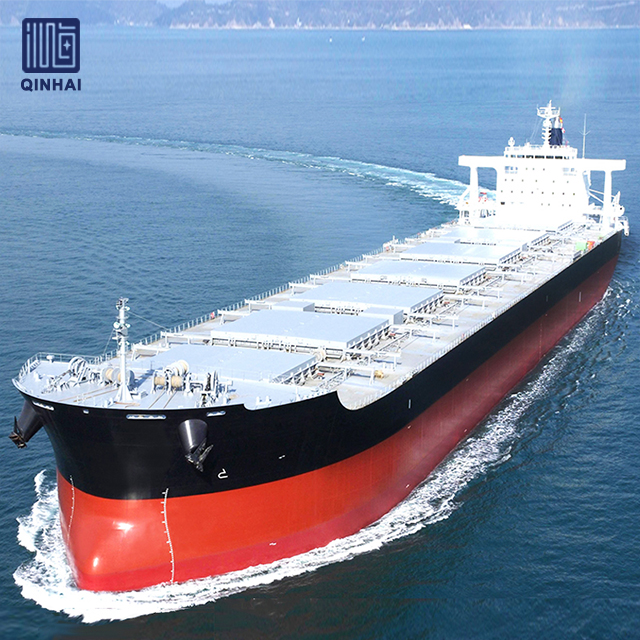
Dedicated ore carriers feature a distinct architectural shift from standard bulkers. They utilize significantly narrower cargo holds. Naval architects achieve this by incorporating steeply sloped upper topside tanks and lower hopper tanks. This geometry restricts the floor area of the hold, forcing the dense ore to stack vertically rather than spreading horizontally across a wide tank top.
This specific design raises the vessel's center of gravity slightly. Raising the center of gravity ensures a smoother rolling period. If heavy ore sits too low in a wide hold, it creates a "stiff ship" phenomenon. A stiff ship has an excessively large metacentric height and snaps back violently from a roll. This violent motion damages structural members, causes severe crew fatigue, and accelerates metal fatigue in the hatch covers, sheer strakes, and lashing bridges.
You must specify heavy-duty tank top plating for any ore carrier. The vessel requires heavily reinforced double-bottom structures to absorb two distinct forces. First, the static weight of the heaped ore presses down constantly during the voyage. Standard bulkers might have a tank top strength of 10 to 15 tonnes per square meter, whereas a dedicated ore carrier requires 20 to 25 tonnes per square meter. Second, the tank tops must withstand the violent impact of heavy grabs during discharge operations. Shore-based unloaders drop massive 35-ton steel grabs into the holds, which easily puncture standard mild steel plating.
Shipbuilders strategically use high-tensile steel (such as AH36 or DH36) in critical stress areas. You will find this specialized steel in hatch corners, sheer strakes, and longitudinal bulkheads. High-tensile steel reduces the overall lightweight of the vessel while maintaining yield strength. However, you must balance this with the risk of fatigue cracking over the vessel's lifespan. High-tensile steel flexes more than mild steel. Proper structural design and heavy framing ensure long-term durability without compromising the hull's rigidity.
Alternate hold loading (AHL) is an absolute operational necessity for large ore carriers. Operators load cargo into odd-numbered holds (like 1, 3, 5, 7, 9) while leaving even-numbered holds (2, 4, 6, 8) completely empty. This loading pattern raises the overall center of gravity and eases the ship's rolling motion in heavy seas. It also speeds up loading and discharge operations since the terminal equipment only needs to access half the holds.
A vessel cannot simply execute this pattern by choice. It requires specific IACS structural notations, typically the BC-A notation, which certifies the vessel for heavy cargoes with specified holds empty. The loaded holds must possess massively reinforced transverse bulkheads to withstand the concentrated weight and shear forces, while the empty holds provide necessary buoyancy. If you attempt alternate hold loading on a standard BC-B or BC-C vessel lacking the proper class notation, the shear forces will snap the hull girder in half.
When evaluating different bulk carrier vessel types, Capesize vessels (100,000 to 200,000 DWT) and VLOCs (up to 400,000 DWT) stand out as the primary workhorses for major deep-sea iron ore routes. These massive ships dominate the trade lanes connecting the Pilbara region in Australia and the Carajás mine in Brazil to major steel manufacturing hubs in Asia. Their sheer size offers unmatched economies of scale, drastically reducing the transport cost per tonne of ore over long distances.
However, you must balance these economies of scale against strict draft and beam limitations at loading and discharge terminals. Capesize vessels require deep-water ports with minimum drafts exceeding 18 meters. Furthermore, these massive vessels are entirely gearless. They lack onboard cranes. They rely entirely on advanced shore-based facilities, such as massive shiploaders and continuous ship unloaders, for cargo operations. This reliance restricts their operational flexibility compared to smaller, versatile bulkers.
Mid-size vessels, such as Panamax, Ultramax, or Handymax, offer excellent utility for secondary routes, transshipment operations, or ports with severe draft restrictions. While standard Panamax vessels often default to coal and grain trades, specially reinforced units with heavy tank tops can handle iron ore safely.
If you are evaluating a 35000 DWT bulk carrier for sale, you must focus on specific evaluation criteria. Check the crane capacity to determine your reliance on geared versus gearless operations. A geared vessel equipped with 30-ton cranes and electro-hydraulic grabs provides access to underdeveloped ports lacking shore infrastructure. Verify the structural readiness for high-density loads. Ensure the inner bottom plating features sufficient thickness to withstand grab damage and that the vessel holds the appropriate class notations for heavy cargo.
Regional short-sea shipping and coastal distribution networks require specialized niche vessels. A 20000 ton bulk carrier fits perfectly into this operational profile. These vessels feed secondary steel mills located away from major deep-water hubs. They offer the agility to navigate restricted coastal waters, enter smaller regional ports, and carry a profitable payload of ore without requiring massive dredging operations.
For even more restricted waterways, operators deploy specialized lightering vessels. The operational profile of a 5000 ton iron ore bulk carrier typically involves river-sea navigation. These vessels execute lightering operations, transferring ore directly from anchored Capesize ships in deep water to shallow-draft inland waterways. They navigate rivers and canals where larger vessels simply cannot operate due to strict air draft limits under bridges and severe under-keel clearance restrictions.
China maintains undisputed dominance in global shipbuilding and bulk carrier output. When sourcing a vessel, partnering with a reliable bulk carrier manufacturer in China provides access to advanced construction techniques, automated panel lines, and efficient delivery schedules. However, you need a strict framework for evaluating a Chinese shipyard before signing a shipbuilding contract.
First, review their portfolio of IACS-classed ore carriers. Verify their experience with high-density cargo vessels and BC-A class notations. Second, inspect their steel cutting and welding automation capabilities. Automated submerged arc welding ensures consistent seam integrity, which is critical for vessels enduring high shear forces. Third, assess their drydock capacity and block assembly methods to ensure they can meet your delivery timelines. Finally, discuss the yard's experience with energy-saving devices. Implementing propeller boss cap fins, Mewis ducts, and air lubrication systems helps vessels meet stringent IMO environmental regulations like EEDI and CII.
Procurement teams must weigh the trade-offs between commissioning a newbuild and acquiring existing tonnage. Newbuilds require longer lead times and higher initial capital expenditure. However, they offer modern fuel efficiency, exact structural customization for your specific trade routes, and full compliance with the latest environmental regulations.
The second-hand market offers immediate vessel availability but hides significant operational risks. You must account for mandatory special surveys and Condition Assessment Programs (CAP). Older vessels often require extensive steel renewal in the cargo holds due to years of grab damage and corrosion from wet ore. You also face the complex engineering task of retrofitting ballast water treatment systems (BWTS) to comply with current maritime laws.
| Evaluation Factor | Newbuild Commissioning | Second-Hand Acquisition |
|---|---|---|
| Lead Time | 18 to 36 months depending on shipyard slot availability. | Immediate availability upon transaction completion. |
| Maintenance Burden | Minimal. Covered by shipyard warranty periods. | High. Steel renewal, special surveys, BWTS retrofits. |
| Customization | Full control over structural class and energy devices. | None. Must adapt operations to existing vessel specs. |
| Environmental Compliance | Built to latest EEDI Phase 3 and CII standards. | Requires engine power limitation (EPL) or retrofits. |
High-speed loading operations place extreme stress on the hull girder. Major export terminals load iron ore at rates up to 10,000 tonnes per hour using massive conveyor systems. This rapid influx of massive weight can warp the hull, causing permanent hogging or sagging if not managed perfectly. The de-ballasting sequence must synchronize flawlessly with the loading rate to maintain structural equilibrium and keep the vessel within its load line limits.
You must equip your vessels with advanced, class-approved loading computers. These systems monitor hull deflection, shear forces, and bending moments in real-time. The chief mate uses this data to adjust the loading sequence instantly, communicating with the terminal to slow down or shift pours. This prevents structural overstress and ensures the vessel remains within safe operational limits throughout the entire port stay.
Mismatching vessel specifications with terminal infrastructure creates severe operational bottlenecks. You face the risk of arriving at a port only to discover your vessel cannot interface with the loading equipment. Air draft restrictions may prevent shore loaders from clearing your hatch covers at high tide. The outreach of discharge grabs might not reach the far corners of your cargo holds, requiring manual bulldozing inside the hold to clear the cargo.
You must conduct strict port compatibility studies prior to finalizing vessel dimensions. Analyze the under-keel clearance at both high and low tides. Evaluate the exact specifications of the shore cranes, including their safe working load and maximum outreach, when deciding between geared and gearless tonnage. Accurate compatibility studies prevent costly delays, demurrage claims, and ensure seamless cargo operations.
An iron ore bulk carrier represents a highly specialized asset where structural integrity, specific gravity management, and durability must take precedence over generic cargo volume metrics. Standard bulkers simply cannot withstand the localized stress and liquefaction risks associated with high-density ores. Your decision framework must prioritize safety, class notations, and route compatibility above all else.
To finalize your shortlisting logic: First, define your specific route, shore-facility reliance, and port draft limits to determine the exact DWT required. Second, mandate an alternate hold loading structural class to ensure safe navigation. Third, rigorously audit the shipyard's construction standards or the second-hand vessel's maintenance history.
A: The primary differences lie in structural engineering. Iron ore carriers feature narrower cargo holds, steeply sloped bulkheads, and heavily reinforced double bottoms. Because iron ore has a much higher specific gravity than grain or cement, ore carriers are designed to safely execute alternate hold loading to manage severe bending moments.
A: Standard bulkers lack the reinforced tank tops and sloped bulkhead geometry required for high-density ore. Loading ore into a standard wide hold concentrates massive weight on a weak surface, risking severe structural damage. Furthermore, standard holds cannot heap the ore properly, increasing the risk of cargo shift and liquefaction.
A: Iron ore is extremely dense. If loaded evenly across all holds, the weight sits too low, creating a "stiff" ship that rolls violently. Loading every other hold raises the vessel's center of gravity. This ensures a smoother rolling period, prevents structural fatigue, and speeds up terminal operations.
A: A dedicated iron ore carrier typically operates for 20 to 25 years. However, heavy grab damage during discharge operations and the corrosive nature of certain wet ores can accelerate wear. Strict maintenance routines, protective coatings, and timely steel renewals are required to reach the maximum lifespan.
A: Capesize and Very Large Ore Carriers (VLOCs) dominate primary global deep-sea trades. Specially reinforced Panamax vessels handle routes with restricted ports. Handysize and Handymax vessels operate on regional or specialized coastal routes where draft limits prevent larger ships from entering.
A: You should check the shipyard's historical delivery record for vessels classed by major IACS members, such as DNV, ABS, or Lloyd's Register. Additionally, audit their welding automation processes, block assembly methods, and verify their compliance with the latest EEDI and CII environmental standards.


