
Views: 0 Author: Site Editor Publish Time: 2026-09-25 Origin: Site


Maritime logistics presents a strict engineering challenge: maximizing payload volume and weight without compromising vessel stability under dynamic ocean conditions. At the center of this operation is the accurate calculation and utilization of bulk carrier cargo hold capacity. Misinterpreting capacity metrics or ignoring the relationship between cargo density and hold structure leads to severe economic inefficiencies through underutilization. Worse, it triggers safety failures, including extreme hull stress, structural fracturing, or rapid capsizing in rough seas. This guide serves as a technical evaluation framework for shipowners, fleet managers, and charterers. By analyzing specific vessel dimensions, structural limitations, and regulatory compliance requirements, maritime professionals can accurately align vessel size with operational routes. Understanding these engineering principles ensures informed procurement decisions, optimizes voyage profitability, and maintains strict adherence to international maritime safety standards.
Vessel buyers and charterers frequently confuse maximum weight capacity with volumetric capacity. This misunderstanding leads to inaccurate profitability projections, especially when transporting lighter, high-volume cargoes. To optimize fleet operations, you must dissect bulk carrier technical specifications and understand how different measurement metrics interact during the load planning phase.
Deadweight Tonnage (DWT) serves as the industry standard for the absolute maximum weight a ship can safely carry. DWT encompasses the entire payload weight, plus fuel oil, diesel, fresh water, ballast water, provisions, crew, and spare parts. Hitting the DWT limit means the vessel has reached its maximum allowable draft at the summer load line. DWT does not tell you how much physical space is available inside the ship.
Cargo hold capacity refers to the internal geometric volume available specifically for the payload. We measure it in cubic meters or cubic feet. The mathematical relationship between DWT and hold capacity relies on deducting structural internals. Manual calculations require naval architects to subtract the volume occupied by corrugated bulkheads, hopper tanks, and internal framing from the gross hold volume. Modern load planning software automates these deductions. It provides real-time volumetric data to ensure the cargo fits physically without exceeding the DWT limit.
Understanding the distinction between grain and bale capacity is necessary for accurate stowage planning. These two metrics define the usable space based on the physical characteristics of the cargo being loaded.
Grain capacity represents the total internal volume of the cargo hold. It includes the spaces between the structural frames, the hatch coamings, and the deck beams. We use this measurement exclusively for free-flowing bulk cargoes like wheat, corn, or coal. Because these materials act like fluids, they flow into every available crevice. They utilize the absolute maximum geometric volume of the hold.
Bale capacity measures the volume available for packaged, unitized, or solid cargo. This measurement stops at the inside edge of the structural frames, spar ceilings, and bulkhead corrugations. Pallets, steel coils, or bagged goods cannot fit into the irregular spaces between the ship's ribs. Consequently, a vessel's bale capacity is always smaller than its grain capacity, typically by about 5 to 10 percent.
| Metric | Definition | Primary Cargo Types | Volume Utilization |
|---|---|---|---|
| Grain Capacity | Total volume including spaces between frames and hatch coamings. | Wheat, coal, soybeans, loose fertilizers. | Maximum theoretical volume. |
| Bale Capacity | Volume measured to the inside edge of frames and spar ceilings. | Steel coils, timber, bagged cement, unitized goods. | Reduced volume (5-10% less than grain). |
The stowage factor is the ultimate variable connecting cargo weight to hold volume. It indicates how many cubic meters one metric ton of a specific cargo occupies. Evaluating the stowage factor is mandatory for matching cargo density to the available hold volume.
High-density cargoes, such as iron ore or steel scrap, have a very low stowage factor. They require significantly less physical volume to reach a high weight. When loading iron ore, the vessel hits its DWT limit while the cargo holds remain largely empty by volume. This concentrates immense weight on a small area of the tank top. It requires heavily reinforced double-bottom structures to prevent structural failure.
Low-density cargoes like wood pellets, barley, or certain types of coal have a high stowage factor. These cargoes require massive amounts of space. When loading low-density cargo, the vessel completely fills its volumetric cargo hold capacity long before it reaches its maximum DWT. Maximizing the geometric volume of the holds dictates the profitability of the voyage in these scenarios.
Before a vessel arrives at the load port, the chief officer conducts a detailed stowage plan. This plan calculates the exact distribution of weight across all holds. The goal is to maximize the cargo intake without exceeding the load line marks or inducing unacceptable bending moments on the hull.
Draft surveys are conducted before and after loading. The surveyor reads the draft marks on the hull to calculate the exact displacement of the water. By subtracting the lightship weight and known constants like fuel and ballast, the surveyor determines the exact weight of the cargo loaded. This physical measurement acts as a final check against the volumetric calculations and shore scale weights.
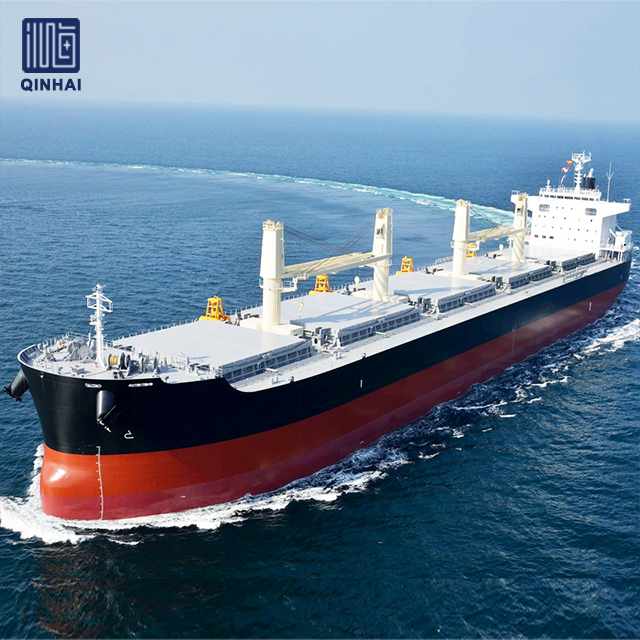
Naval architects balance physical dimensions with operational necessities. A ship cannot simply be a hollow steel box. It requires complex internal geometry to maintain stability, achieve hydrodynamic efficiency, and facilitate cargo operations. These structural necessities directly encroach upon the available cargo hold capacity.
Bulk carriers spend a significant portion of their operational life sailing empty to pick up their next cargo. Without payload weight, a massive steel ship rides too high in the water. This exposes the propeller and rudder. This lack of immersion destroys maneuverability, reduces propulsion efficiency, and induces severe hull slamming in rough seas.
To counteract this, bulk carriers require exceptionally high ballast water capacity. The necessity of these large ballast tanks fundamentally shapes the cargo hold. Topside wing tanks and hopper wing tanks integrate into the design. While these tanks consume potential cargo volume, they serve a dual purpose. Their angled surfaces create a self-trimming hold geometry. They direct loose bulk cargo toward the center of the hold directly under the hatch opening. This drastically speeds up unloading operations using grabs.
Modern hull forms optimize hydrodynamic efficiency while attempting to maximize the rectangular volume of the holds. The traditional cruiser stern has been almost entirely replaced by the transom stern in modern bulk carrier design. A transom stern provides a flat surface at the aft of the ship. It improves water flow separation, reduces drag, and increases propulsion efficiency.
More importantly for capacity, a transom stern allows the parallel midbody of the ship to extend further aft. This is the widest, most rectangular section where cargo holds are located. This maximizes the usable geometric volume within the hull before the lines must taper inward toward the steering gear and engine room.
Creating larger, uninterrupted cargo holds improves loading and discharging efficiency. It reduces the number of hatch covers and minimizes the movement of shore-based loaders. However, long, continuous holds compromise the transverse structural rigidity of the vessel.
Transverse bulkheads are essential for maintaining the ship's structural integrity against torsional stress and hydrostatic pressure. Naval architects face a constant trade-off. They can increase the length of the holds to improve cargo handling speed, or increase the number of bulkheads to enhance safety and allow for multi-grade cargo segregation. These bulkheads are typically corrugated rather than flat. Corrugation provides superior strength against bending moments without requiring heavy internal stiffeners that would trap cargo and reduce usable volume.
The physical dangers of improper loading are immense. The International Maritime Organization (IMO) and the International Association of Classification Societies (IACS) enforce strict regulatory frameworks designed to mitigate these implementation risks. Ignoring these regulations compromises the vessel and endangers the crew.
The forward-most cargo hold (Hold No. 1) is exceptionally vulnerable to structural damage from heavy seas, rogue waves, or collisions. IACS findings indicate that if a ship is flooded in the forward hold, the resulting hydrostatic pressure can overwhelm the transverse bulkhead separating Hold No. 1 from Hold No. 2.
If this bulkhead fails, progressive flooding occurs. It pulls the ship's bow under the water and leads to rapid sinking. Consequently, regulations mandate heavily reinforced corrugated bulkheads between the foremost holds. These structural reinforcements require thicker steel and deeper corrugations. They marginally reduce the available cargo hold capacity in the forward section of the vessel.
Bulk cargoes are susceptible to shifting during transit, particularly in rough sea conditions. Certain granular cargoes, such as nickel ore or bauxite, possess high moisture content. Under the constant vibration of the ship's engines and the rolling motion of the ocean, these cargoes can undergo liquefaction. They transition from a solid state into a dense, muddy liquid.
When cargo liquefies, it sloshes to one side of the hold as the ship rolls but does not return when the ship rights itself. This uneven distribution creates a landslide effect inside the hold. The sudden shift in the center of gravity can cause a ship to capsize in a matter of minutes. Hold design, specifically the angle of the hopper tanks, helps restrict this movement. Strict loading protocols, including mandatory moisture limit testing, are enforced to prevent liquefaction before the vessel ever leaves port.
Loading thousands of tons of cargo into a steel hull induces massive shear forces and bending moments. If heavy cargo is loaded too quickly into the midship holds while the ends remain empty, the hull experiences sagging. If the ends are loaded while the midship is empty, the hull experiences hogging. Both conditions can snap a vessel's keel.
Approved loading manuals dictate exact loading sequences. For high-density cargoes like iron ore, vessels employ strict procedures to manage stress:
Vessels often employ alternate hold loading for heavy ores. They load holds 1, 3, and 5 while leaving 2 and 4 empty. This raises the center of gravity slightly, creating a more comfortable roll period for the vessel. It concentrates immense stress on the loaded holds. The tank tops and bulkheads of these specific holds must be engineered with thicker steel plating to withstand the localized pressure.
Matching vessel classifications to specific commercial use cases requires evaluating draft limits, shore-based loading equipment, and route distances. Different vessel sizes are engineered to solve specific logistical challenges.
For regional transport and shallow-water ports, operators frequently deploy a 5000 ton iron ore bulk carrier. These vessels are optimized for short-sea shipping routes where rapid turnaround times are prioritized over massive economies of scale.
Design priorities for this class include a shallow draft to navigate river estuaries and coastal berths. Because they frequently carry high-density materials like iron ore or steel products, their tank tops are heavily reinforced. The cargo hold capacity is relatively small by volume, but the structural integrity is exceptionally high to handle the concentrated weight. These vessels often feature box-shaped holds to facilitate the easy loading of steel coils or heavy machinery on return voyages, maximizing their utility.
The Handysize sector is the workhorse of the global dry bulk fleet. A typical 20000 ton bulk carrier offers unparalleled operational versatility. These vessels are highly economically viable for servicing secondary ports with strict draft restrictions and limited shore-based infrastructure.
Most Handysize vessels are geared. They are equipped with their own deck cranes and grabs. This self-sustaining capability allows them to discharge cargo in remote ports or directly into barges at anchorages where shore cranes are unavailable. Their cargo hold capacity is divided into four or five holds. This allows them to carry different parcels of cargo simultaneously, such as fertilizers, grains, and minor ores. They are highly adaptable to fluctuating regional market demands.
When scaling up operations for deep-sea routes, decision-makers often evaluate a 35000 DWT bulk carrier for sale. The Handymax and Supramax classes strike a precise balance between the economies of scale required for transoceanic voyages and the flexibility to enter a wide variety of global ports.
These vessels typically feature five cargo holds. They provide substantial volumetric capacity for low-density cargoes like grain, while maintaining the structural strength necessary for coal or bauxite. The multi-hold configuration allows charterers to load diverse, multi-grade cargoes on a single voyage. When evaluating this class, buyers must scrutinize the crane lifting capacity and the outreach of the jibs to ensure compatibility with intended discharge facilities.
Mitigating financial and operational risks during the acquisition phase requires rigorous technical vetting. The physical build quality of the cargo holds dictates the lifespan and maintenance requirements of the vessel.
Procuring a vessel requires evaluating the technical capabilities of the builder. When assessing a bulk carrier manufacturer in China or other major shipbuilding hubs, buyers must look beyond the blueprint dimensions. The integrity of the cargo hold capacity relies entirely on the execution of the construction.
Evaluation criteria must focus on steel cutting precision, automated welding standards, and the application of marine coatings. Poor welding in the corrugated bulkheads or hopper tanks leads to stress fractures and water ingress. The shipyard must demonstrate strict adherence to IACS Common Structural Rules (CSR). These rules dictate the fatigue life and steel thickness requirements for modern bulk carriers.
Pay close attention to the steel grades used in the cargo holds. High-tensile steel, such as AH36 or DH36, is frequently used to reduce the overall weight of the vessel while maintaining structural strength. However, high-tensile steel is thinner than mild steel of equivalent strength. This makes it more susceptible to corrosion and physical wear from heavy loading grabs. Grabs used to discharge coal or iron ore routinely strike the tank tops and hopper tanks. Over years of operation, these impacts cause significant steel wastage. Specifying thicker mild steel for the tank tops during the procurement phase adds initial weight but drastically extends the operational lifespan of the holds.
Shipowners must weigh the upfront costs of custom hold configurations against the long-term return on investment of standard, off-the-shelf shipyard designs. Standard designs benefit from proven engineering, faster delivery times, and readily available spare parts.
Specific trade routes may necessitate customization. Vessels intended for the corrosive sulfur trade require specialized epoxy coatings inside the cargo holds. Ships operating in ice-prone regions require thicker hull plating and reinforced framing. This marginally reduces internal volume but ensures year-round operational capability. Buyers must calculate whether the specialized cargo premiums justify the initial customization expenses.
True economic viability requires operating a bulk carrier at full capacity year-round. A vessel sitting idle or sailing half-empty rapidly consumes capital. Achieving continuous utilization is heavily dependent on matching the vessel's cargo hold capacity to the infrastructure of the destination ports.
Procurement models must analyze projected route utilization, seasonal cargo fluctuations, and port turnaround times. If a vessel's capacity exceeds the draft limits of a primary destination port, it must short load. Sailing below its DWT destroys the voyage's profitability. Purchasing a vessel too small for a high-volume route leaves economies of scale on the table. The vessel's dimensions must align perfectly with the shore-based loaders, conveyor systems, and draft restrictions of the intended trade lanes.
To move forward with your fleet expansion or vessel replacement strategy, execute the following steps:
A: Capacity is calculated by measuring the total internal geometric volume of the holds and deducting the space occupied by structural internals like hopper tanks, corrugated bulkheads, and framing. Modern load planning software automates these deductions, combining the volume with the cargo's stowage factor to ensure the final load maximizes space without exceeding the vessel's Deadweight Tonnage (DWT).
A: Grain capacity measures the total internal volume, including spaces between structural frames, used for free-flowing cargo like wheat or coal that fills every crevice. Bale capacity measures the slightly smaller volume up to the inside edge of the frames, used for packaged or unitized goods that cannot fit into irregular spaces.
A: Large ballast tanks are essential for safe navigation when the vessel is traveling empty. Filling these tanks with seawater lowers the ship into the water, achieving proper draft and propeller immersion. This ensures maneuverability, maintains propulsion efficiency, and prevents severe hull slamming in rough ocean conditions.
A: Primary structural risks include forward hold flooding, which can overwhelm transverse bulkheads and cause rapid sinking. Other risks involve hull stress from uneven loading sequences causing sagging or hogging, and the catastrophic shifting or liquefaction of cargo in rough seas, which can lead to the vessel capsizing in minutes.
A: High-density cargo like iron ore causes the vessel to reach its maximum weight limit quickly, leaving the cargo holds partially empty by volume and concentrating stress on the tank top. Low-density cargo like grain fills the entire volumetric capacity of the holds long before the vessel reaches its maximum weight limit.
A: The stowage factor is a metric indicating the volume occupied by one metric ton of a specific cargo, usually expressed in cubic meters or cubic feet per ton. It is a crucial variable for load planning, determining exactly how much of a hold's volumetric capacity will be utilized by a given weight of cargo.


