
Views: 0 Author: Site Editor Publish Time: 2026-09-29 Origin: Site


Commissioning a custom commercial vessel requires navigating a complex matrix of engineering tolerances, regulatory frameworks, and capital-intensive supply chains. Off-the-shelf vessel templates often fail to meet highly specific operational requirements. Fleet managers frequently encounter catalog designs that compromise on payload efficiency, draft limits, or fuel consumption for their specific routes. Yet fully bespoke builds introduce significant timeline, budget, and integration risks if the shipyard's processes are not rigorously managed from day one. A minor miscalculation in the initial general arrangement can cascade into massive structural rework during physical assembly. This guide deconstructs the end-to-end custom shipbuilding process. We provide fleet managers, maritime operators, and procurement officers with an evidence-based framework to navigate multi-year construction projects. You will learn how to evaluate manufacturers, manage technical specifications, and mitigate project risks from conceptual design to final handover.
Before drafting a single hull line, operators must define primary operational parameters. You need exact figures for payload capacity, draft restrictions, speed requirements, and route-specific environmental conditions. A vessel operating in the shallow river systems of Southeast Asia demands entirely different hull hydrodynamics and cooling systems than one crossing the North Atlantic in winter. Operators must also define ice-class requirements, port infrastructure limitations, and expected turnaround times.
Evaluate the conceptual trade-offs between commissioning a fully bespoke design versus adapting an existing template from a custom commercial vessel manufacturer. Fully custom builds require higher upfront engineering costs and longer lead times. They allow for zero-compromise operational efficiency, optimizing every square meter of deck space. Modified catalog ships offer faster delivery and proven hydrodynamic performance. However, they force operators to accept minor compromises in cargo layout, auxiliary power generation, or fuel efficiency.
| Parameter | Fully Custom Build | Modified Catalog Template |
|---|---|---|
| Engineering Lead Time | 9 to 12 months | 3 to 5 months |
| Hull Optimization | 100% route-specific | Standardized block coefficient |
| Technical Risk | High (untested hydrodynamics) | Low (proven sea trials) |
| Yard Selection | Requires specialized engineering yards | Available at high-volume production yards |
Different vessel classes require distinct engineering approaches. When defining LCT cargo vessel types, operators must outline requirements for bow ramp articulation, winch capacities, and deck load capacities. You measure deck strength in tons per square meter. A standard deck might support 5 t/m², but heavy tracked machinery requires 15 t/m² to prevent plating deformation. Shallow draft capabilities and specialized ballast systems remain strictly necessary for unimproved port access and safe beach landings. Engineers must design heavy skegs to protect the propellers and rudders during grounding operations.
For bulk carrier vessel types, define parameters for cargo hold configurations and hydraulic hatch cover systems. Specify whether the vessel requires self-unloading gear or heavy-lift cranes. Deadweight tonnage (DWT) optimization directly dictates the revenue potential per voyage. Engineers must factor in grab damage reinforcement for the inner bottom plating. High-tensile steel is often used in hopper tanks and topside tanks to withstand aggressive port unloading operations and highly abrasive cargoes like iron ore or bauxite.
Strict compliance governs oil tanker technical specifications. You must detail requirements for double-hull construction and segregated ballast tanks to meet international spill prevention mandates. Specialized pumping and piping systems demand high-grade, corrosion-resistant materials. Deep well pumps in each tank offer better stripping capabilities than a centralized pump room. Hazardous area electrical classifications dictate the exact type of wiring, sensors, and explosion-proof fixtures installed throughout the vessel's cargo zones. Inert gas systems (IGS) and vapor emission control systems (VECS) are mandatory to prevent atmospheric combustion.
The General Arrangement (GA) drawing serves as the foundational blueprint. Naval architects translate operational requirements into initial hull forms, deck layouts, and machinery space allocations. This phase locks in the vessel's physical footprint and internal volume distribution. The design spiral begins here. Architects balance weight estimates against buoyancy and payload requirements. They determine frame spacing, watertight bulkhead placement, and superstructure positioning.
Engineers conduct preliminary hydrodynamic modeling using computational fluid dynamics (CFD). They analyze wave-making resistance, frictional resistance, and wake fractions. They perform intact and damage stability calculations to ensure the vessel rights itself under extreme list angles or hull breaches. Speed-power predictions validate the core viability of the hull shape against the proposed main engine output. If the hull resistance is too high, architects adjust the block coefficient and bow profile before proceeding to structural detailing.
You must engage Classification Societies early in the design phase. Organizations like DNV, ABS, or Lloyd's Register review structural drawings and safety systems against strict class rules. They verify longitudinal strength, fatigue limits, and machinery redundancy. Late engagement guarantees costly redesigns and delayed steel cutting.
Map out compliance requirements for International Maritime Organization (IMO) regulations. MARPOL dictates environmental standards, including Tier III emissions compliance and ballast water treatment systems. SOLAS governs the safety of life at sea, dictating fire zone boundaries, structural fire protection, and life-saving appliance placement. Local maritime authority mandates also apply based on the vessel's intended flag state and operational theater.
Conceptual design transitions into granular 3D modeling of structural, piping, and electrical systems. Draftsmen model every steel plate, longitudinal stiffener, pipe spool, and cable tray. This generates the production data required for the shop floor.
Design for Manufacturability (DFM) is non-negotiable. You must align the vessel's design with the specific shipyard's production methodology. Engineering data must translate directly to their CAD/CAM systems. A design optimized for a highly automated yard with robotic welding will fail in a yard relying on manual assembly. The block division strategy must match the lifting capacity of the yard's gantry cranes. If a yard has 200-ton cranes, designing 300-ton grand blocks halts production.
Engineers deploy clash detection software to identify physical interferences before fabrication begins. Finding a 12-inch cooling pipe routed through a primary structural bulkhead on a computer screen costs nothing to fix. Finding it during physical assembly halts production and requires class-approved structural modifications. This phase generates the precise Bill of Materials (BOM), piping isometric drawings, and CNC cutting files.
Procurement runs parallel to detailed engineering. Identify critical long-lead items that must be ordered months in advance. Main engines, propulsion thrusters, specialized cargo handling equipment, and custom switchboards often carry lead times exceeding 12 to 18 months. You must schedule Factory Acceptance Tests (FAT) at the vendor's facility before these components ship to the yard.
Mitigating supply chain risks prevents delays that threaten the entire build schedule. Source backup vendors for critical valves, pumps, and automation modules. Lock in steel supply early through bulk purchasing agreements. Late delivery of a single main engine block or automation console will derail the outfitting sequence and delay the vessel's launch.
Shipyards divide production stages theoretically and practically. They separate hull construction workflows from outfitting workflows to maximize yard efficiency. Steel workers, pipefitters, and electricians operate on different, tightly sequenced schedules to prevent workspace congestion inside the hull blocks.
The transition from digital engineering to physical production starts at the steel cutting facility. CNC plasma or laser cutting machines slice raw marine-grade steel plates into precise shapes based on the CAD files. Nesting software optimizes the cutting patterns to minimize scrap steel. Workers prime the steel with zinc silicate to prevent corrosion during the assembly phase.
The keel laying milestone holds massive operational and contractual significance. It marks the formal start of physical assembly on the slipway or in the dry dock. This event often triggers a major payment phase and initiates the first wave of physical regulatory inspections by the classification society surveyor.
Modern shipyards no longer build vessels plate-by-plate from the ground up on a slipway. They assemble steel plates into sub-assemblies, and then into modular blocks in controlled workshop environments. This protects welding processes from weather delays, controls ambient humidity, and vastly improves quality control. Shipyards utilize Submerged Arc Welding (SAW) for long, straight panel seams to ensure deep penetration and high deposition rates. Flux-Cored Arc Welding (FCAW) is deployed for out-of-position welds inside the blocks.
Pre-outfitting generates massive efficiency gains. Yard workers install piping spools, cabling trays, ventilation ducts, and machinery foundations within individual blocks before they are welded together. Completing this work while the block is open on the shop floor takes a fraction of the time compared to dragging heavy cables through tight, enclosed hull spaces later in the build. Hot work (welding and cutting) must be completed before cold work (cable pulling and painting) begins.
Heavy lift gantry cranes move pre-outfitted blocks to the dry dock or slipway for joining. Shipwrights use laser trackers for dimensional control, ensuring blocks align within millimeter tolerances. Welders connect the blocks to form the complete hull. Inspectors mandate rigorous non-destructive testing (NDT). They use radiographic (X-ray) testing for hull envelope welds and ultrasonic testing for internal structural connections. Magnetic particle and dye penetrant tests verify surface integrity.
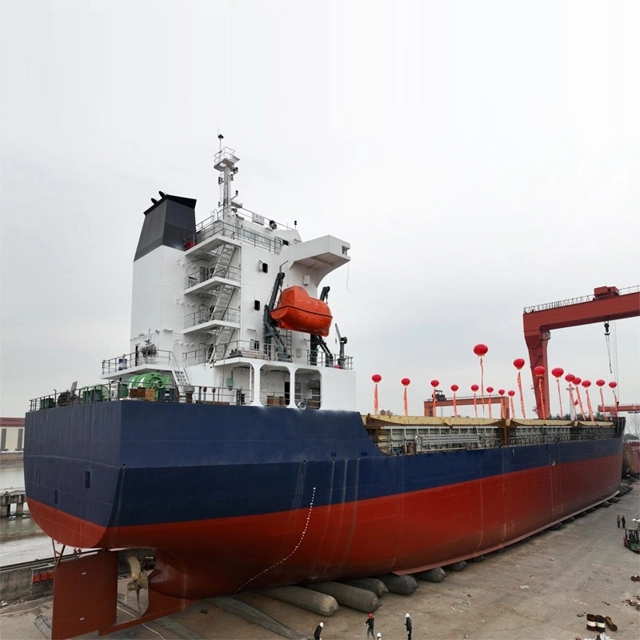
Launching methods vary by shipyard infrastructure. Dry dock flooding is the safest method, gently lifting the hull as water enters the basin. Slipway launching introduces high dynamic stresses as the vessel slides backward into the water, requiring temporary structural reinforcement. Marine airbag launching offers flexibility for smaller yards but requires precise weight distribution calculations to prevent hull buckling during the roll.
Once afloat, the vessel enters the final outfitting phase at the commissioning pier. Technicians install sensitive navigational equipment, radar arrays, interior accommodations, and HVAC systems. Marine coating systems require strict environmental controls. Painters apply anti-corrosive epoxy primers followed by specialized antifouling topcoats on the underwater hull to prevent marine growth and maintain hydrodynamic efficiency.
They make the final machinery connections, aligning the main engine to the propeller shaft using optical sights or laser alignment tools. Resin chocking compounds are poured to secure the heavy machinery to the hull foundations. Deck machinery installation includes mooring winches, windlasses, and fairleads. These components must be structurally integrated into the deck plating with heavy insert plates to handle massive dynamic towing and mooring loads.
Integrating proprietary software and control systems across different equipment vendors presents a major challenge. The main engine control system must communicate flawlessly with the bridge telegraph, the power management system, and the alarm monitoring system. Protocol mismatches require immediate troubleshooting by automation engineers to ensure seamless vessel operation.
Harbor Acceptance Trials (HAT) involve the static testing of electrical, piping, and safety systems while the vessel remains moored. Engineers run generators up to full load using external load banks. They test fire pumps, verify steering gear hydraulics, and calibrate tank sounding systems. An inclining experiment is conducted to determine the vessel's exact lightship weight and center of gravity. Pipefitters conduct hydrostatic pressure tests on all fluid systems to verify weld integrity.
Sea Trials represent the final hurdle. The crew conducts rigorous dynamic testing at sea under the supervision of class surveyors and owner representatives. They verify speed, maneuverability, endurance, and fuel consumption against the contractual guarantees. Crash-stop tests prove the vessel's emergency braking capability. Turning circle and zig-zag maneuvers validate the steering gear performance. Only after passing these trials does the classification society issue the final operational certificates.
Global steel weight prices and raw material indices heavily impact baseline costs. A sudden spike in marine-grade steel directly inflates the build price. Copper prices dictate the cost of the hundreds of kilometers of cabling required for modern custom commercial vessels. Equipment origin also plays a role; specifying European-made pumps and purifiers will cost more than sourcing local equivalents.
Shipyard location presents distinct economic hurdles. Dominant Asian shipbuilding hubs offer massive production capacities, scaled supply chains, and lower labor rates. Western shipyards often carry higher labor costs but specialize in highly complex, low-volume builds or vessels requiring specific domestic compliance. Geography dictates freight costs for imported components and heavily impacts the final custom vessel price quote.
Advanced propulsion systems alter the budget significantly. Conventional diesel systems cost less upfront. Dual-fuel or hybrid-electric systems require heavy initial capital for battery banks and specialized fuel handling systems, but they lower long-term emissions compliance costs. Operators must also factor in the cost of third-party classification inspections, which scale with vessel complexity.
Standard shipbuilding contracts utilize milestone payments to manage cash flow and mitigate risk for both parties. Typical milestones include contract signing, steel cutting, keel laying, launching, and successful sea trials. Each milestone requires verification by the owner's representative before funds are released. Industry-standard contract forms, such as the SAJ or AWES forms, provide a baseline for negotiations.
You must integrate penalty clauses for delayed delivery, known as liquidated damages. Performance guarantees protect the buyer if the vessel fails to meet contracted speed, cargo capacity, or fuel consumption metrics during sea trials. Contracts should also include refund guarantees backed by reputable banks to protect the buyer's initial installments if the shipyard defaults.
A: The timeline ranges from 18 to 36 months depending on vessel complexity. Conceptual design and engineering take 4 to 8 months. Procurement of long-lead items runs concurrently. Physical construction, from steel cutting to launching, requires 10 to 20 months. Final outfitting and sea trials consume the remaining 4 to 8 months.
A: A fully custom build starts from a blank sheet, optimizing every hull line and system for a specific route or payload. It requires higher upfront engineering investment and longer lead times. A modified catalog ship uses a shipyard's existing, proven hull design but customizes the deck layout, cargo handling gear, and interior accommodations to save time and reduce technical risk.
A: Asian shipyards typically offer lower baseline quotes due to scaled supply chains, high-volume production efficiencies, and lower labor rates. Western shipyards often quote higher prices but provide specialized expertise in complex offshore vessels or domestic regulatory compliance. Geography also impacts the freight costs of importing specialized machinery to the yard.
A: You must provide a detailed Statement of Requirements (SOR). This includes exact payload capacity, desired transit speed, maximum draft, classification society preference, flag state, and specific cargo handling requirements. Without this granular data, shipyards can only provide rough order-of-magnitude estimates based on historical tonnage rates.
A: Regulatory compliance mandates double-hull construction to prevent spills during groundings. Specifications must include segregated ballast tanks, inert gas systems (IGS) to prevent cargo tank explosions, and specialized vapor recovery systems. Electrical installations in hazardous zones must meet strict explosion-proof ratings defined by the classification society and SOLAS regulations.
A: Classification societies dictate the engineering standards. They review all structural drawings and inspect physical welds throughout the build. Failing to align with class rules early causes massive delays and expensive rework. Their inspection fees add direct costs, but their approval is legally required to insure, register, and operate the commercial vessel.
A: LCT designs must prioritize shallow draft capabilities and flat bottom hulls for unimproved beach landings. The bow ramp must handle the weight of specific rolling cargo and articulate correctly on uneven terrain. Deck plating requires high point-load reinforcement to support heavy tracked machinery without structural buckling during loading operations.


