
Views: 0 Author: Site Editor Publish Time: 2026-09-22 Origin: Site


Offshore logistics operate on strict margins. Underestimating deck capacity leads to extra voyages, wasting fuel and delaying critical drilling operations. Overestimating capacity compromises vessel stability, putting the crew at risk and violating maritime safety regulations. Fleet managers and offshore operators face a constant challenge. They must match vessel specifications to specific field requirements. Deep-water drilling support demands different capabilities than shallow-water maintenance. Operators need the right tonnage without overspending on unnecessary vessel size.
Evaluating an offshore support vessel requires looking far beyond simple gross tonnage. You must analyze the clear deck area and structural deck load ratings. You also need to understand the complex interplay between above-deck cargo and below-deck tank utilization. Transporting personnel alongside heavy equipment further complicates the available space. Finding the optimal balance ensures safe, efficient, and compliant offshore operations.
Understanding offshore supply vessel deck capacity requires distinguishing between physical space and legal weight limits. Clear deck area refers to the usable square meterage on the main deck aft of the superstructure. This space holds oversized cargo like 30-inch casing, 5-inch drill pipes, standard 10-foot offshore containers, and specialty subsea tools. However, having a massive clear deck does not automatically mean the vessel can carry a massive payload. The actual weight the vessel can legally and safely transport is a separate metric entirely. It depends on the ship's structural design, buoyancy, and current draft.
The industry benchmark for deck cargo weight typically falls between 800 and 3,000 metric tons. Standard supply vessels usually handle the lower end of this spectrum, carrying between 800 and 1,500 metric tons. These vessels service shallow-water rigs or perform routine maintenance runs. Larger Platform Supply Vessels (PSVs) dictate higher limits. These robust ships can transport up to 3,000 metric tons of topside cargo. The vessel class directly influences these operational thresholds. A larger hull provides the buoyancy needed to support heavier deck loads without submerging the load line.
Gross deck area often looks impressive on paper, but real-world operations quickly reduce this available space. Integrating firefighting (FiFi) monitors and their associated piping takes up valuable square meterage along the cargo rails. Oil spill response equipment, such as containment booms and skimmers, requires dedicated deck footprints. Furthermore, vessels transporting offshore workers must maintain clear, safe transit corridors. You cannot stack cargo in designated escape routes or block access to muster stations and fast rescue crafts. These mandatory safety requirements significantly shrink the usable clear deck area.
Deck load rating is a structural metric expressed in metric tons per square meter (t/m²). Standard ratings range from 5.0 to 10.0 t/m². This number defines localized deck strength. A massive deck area is useless for heavy offshore infrastructure if the structural rating cannot support the point load. Heavy machinery, coiled tubing units, and concentrated loads will buckle a weak deck. Operators must match the cargo footprint to the specific deck load rating. When transporting heavy, concentrated loads, crews often lay down heavy wooden dunnage to distribute the weight across multiple deck frames, preventing structural deformation.
Evaluating offshore supply vessel technical specifications starts with Deadweight Tonnage (DWT). DWT encompasses all variable weights on the ship. This includes deck cargo, below-deck bulk, fuel, fresh water, provisions, and the crew. Ships operate under strict draft restrictions dictated by their Plimsoll lines. The hull can only sit so deep in the water before it becomes unsafe. Maximizing deck cargo requires reducing below-deck loads. You must maintain the required draft and legal freeboard to ensure seaworthiness and prevent green water from washing over the deck during transit.
Operators face a constant balancing act between below-deck and above-deck cargo. Below-deck tanks often hold up to 1,200 cubic meters of liquid cargo. This includes heavy liquid mud, brine, potable water, drill water, and excess marine gas oil. Filling these tanks increases the vessel's total weight. It lowers the center of gravity, which improves stability, but it eats into the available DWT. If you need to carry maximum heavy drill pipes on deck, you must sail with partially empty below-deck tanks. It is a strict operational trade-off. You cannot max out both simultaneously without sinking the vessel past its legal load line.
| Vessel Class | Typical Hull Length | Clear Deck Area | Deck Cargo Capacity | Standard Deck Load Rating | Primary Operational Role |
|---|---|---|---|---|---|
| Standard OSV | 50m - 65m | 500m² - 750m² | 800 - 1,500 MT | 5.0 t/m² | Shallow water support, routine supply runs |
| Medium PSV | 65m - 75m | 750m² - 900m² | 1,500 - 2,200 MT | 7.5 t/m² | Mid-water drilling support, ROV operations |
| Large PSV | 80m - 95m | 900m² - 1,100m²+ | 2,200 - 3,000 MT | 10.0 t/m² | Deep-water drilling, heavy subsea construction |
The vessel's approved stability booklet dictates operational limits. This manual outlines the maximum allowable deck cargo heights and weights based on the ship's metacentric height (GM). Stacking containers three-high on the deck raises the ship's center of gravity. It also creates a massive windage area. High windage impacts Dynamic Positioning (DP) system performance. The DP thrusters must work significantly harder to maintain station-keeping capabilities against strong offshore winds when the deck is fully loaded. Exceeding stability limits risks catastrophic capsizing, especially when turning the vessel in heavy seas.
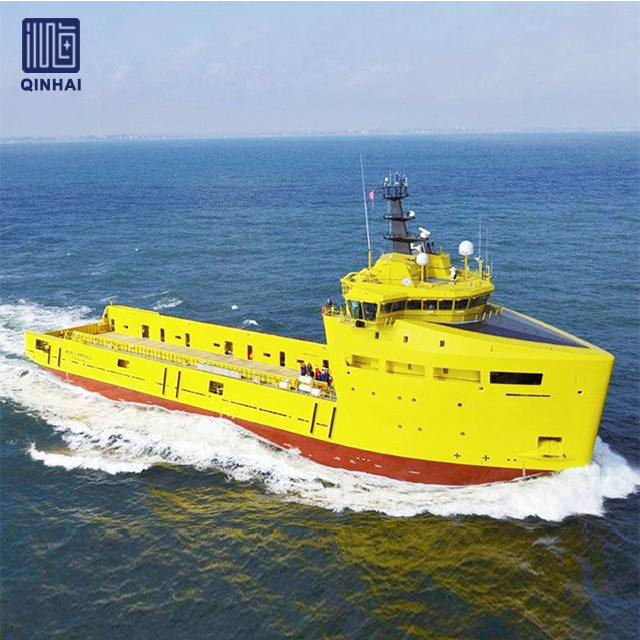
The 85-meter hull length represents a strategic sweet spot in offshore logistics. It offers a superior balance of payload capacity, maneuverability, and fuel efficiency. Consider a smaller 58-meter vessel. It might offer a 715m² deck and a 1,500 MT capacity. However, it lacks the massive below-deck volume of an 85m hull. The 85m class also provides exceptional heavy-weather stability. A 58-meter hull pitches violently in Sea State 4, forcing a reduction in speed and risking cargo shift. The 85m hull bridges the wave crests better, maintaining transit speeds and keeping operations running when smaller vessels are forced back to port.
When evaluating an 85m offshore supply vessel for sale, buyers must use a strict decision framework. Prioritize specific technical specifications over general aesthetics. Look for advanced DP2 capabilities with redundant systems for precise station-keeping near oil rigs. Evaluate the integrated safety systems, including the capacity of the firefighting monitors. Examine the hull design and propulsion systems for transit efficiency. Finally, analyze the cargo-to-hull ratio. The vessel should offer maximum payload capacity without compromising its structural integrity or requiring excessive draft.
The 85m class excels in demanding offshore environments. These vessels dominate deep-water drilling support operations. They carry massive quantities of liquid mud below deck and heavy casing pipes above deck simultaneously. They also serve as excellent subsea construction support vessels. Their large decks easily accommodate Remote Operated Vehicles (ROVs), launch and recovery systems (LARS), and heavy subsea modules. Remote platform supply missions also rely heavily on this class. The 85m vessel can deliver maximum combination cargoes in a single, highly efficient voyage, reducing the total number of trips required to supply a distant rig.
Procuring offshore tonnage involves choosing between newbuilds and secondhand vessels. Commissioning a new vessel allows for exact customization. You can specify the exact deck load rating, tank configurations, and thruster capacities required for your specific field. However, newbuilds require significant lead times, often taking 18 to 24 months from steel cutting to delivery. Purchasing from the existing global fleet of commercial vessels for sale offers immediate availability. Secondhand vessels require thorough condition surveys. You must inspect the deck plating for structural fatigue, check the cargo rails for impact damage, and assess the wear on the propulsion systems through oil sample analysis.
Vetting a China offshore supply vessel supplier requires strict due diligence. International shipyards offer competitive advantages, but quality control is paramount. Focus heavily on International Association of Classification Societies (IACS) certification. Ensure the vessel meets standards set by ABS, DNV, or Bureau Veritas. Inspect the build quality directly. Verify the steel thickness on the main deck and hull using ultrasonic thickness measurements (UTM). Review the shipyard's historical delivery track record. A proven history of building high-capacity, reliable vessels using marine-grade AH36 steel is non-negotiable.
Deck capacity directly influences long-term operational efficiency and maintenance factors. Pushing a vessel to its maximum draft increases hull resistance. This significantly drives up fuel consumption during transit, burning more marine gas oil per nautical mile. Heavy deck cargo also accelerates wear and tear on the vessel's infrastructure. You must budget for the regular maintenance and replacement of timber sheathing or steel deck plating. Furthermore, larger vessels with higher capacities incur higher port fees, pilotage costs, and docking charges based on their gross tonnage. You must balance the benefit of carrying more cargo against the increased daily running logistics.
Exceeding deck capacity introduces severe operational risks. Overloading compromises the vessel's intact stability. It lowers the freeboard and increases the risk of taking green water over the deck, which can damage cargo and sweep personnel overboard. Improper weight distribution is equally dangerous. Placing heavy loads too far aft or off-center causes dangerous list and trim issues, making the vessel difficult to steer. These stability failures can lead to regulatory detainment by port state control. In worst-case scenarios, overloading leads to structural failure or capsizing in rough seas.
Proper cargo securing is a strict technical requirement governed by the Code of Safe Practice for Cargo Stowage and Securing (CSS Code). Sea fastening prevents heavy equipment from shifting during transit. Operators must utilize engineered lashing points, heavy-duty D-rings, tugger winches, and steel pipe stanchions. Adverse weather conditions legally alter cargo limits. When navigating through storms, the dynamic forces on the cargo multiply due to roll, pitch, and heave. Captains must often reduce allowable deck cargo limits to maintain safety margins. Weather routing plays a crucial role in protecting both the vessel and the payload.
Maritime regulatory frameworks strictly govern deck cargo transport. Compliance with International Maritime Organization (IMO) regulations is mandatory. The Safety of Life at Sea (SOLAS) convention dictates strict stability and safety standards. Specific flag state requirements also apply. A primary safety focus is protecting the crew. Escape routes must remain entirely clear of cargo at all times. Offshore workers must have unobstructed access to lifeboats, life rafts, and muster stations. Safety compliance overrides all cargo capacity desires; a vessel will not be permitted to leave port if cargo blocks a single designated safe haven.
A: The average deck cargo capacity ranges from 800 to 1,500 metric tons for standard vessels. Larger Platform Supply Vessels (PSVs) can scale up to 3,000 metric tons. This capacity depends heavily on the vessel's overall deadweight tonnage and structural deck strength.
A: Clear deck area is the measurement of usable square meters aft of the superstructure. The calculation strictly excludes spaces occupied by winches, ventilation shafts, specialty tools, and mandatory personnel safety zones.
A: A standard deck load rating typically falls between 5.0 and 10.0 metric tons per square meter. This rating is critical for determining if the deck can structurally support heavy, concentrated point loads like drill pipes.
A: No. Deadweight Tonnage and strict draft limits constrain total capacity. Carrying 1,200 cubic meters of below-deck liquids consumes available DWT, requiring a reduction in above-deck payload to maintain legal and safe draft levels.
A: PSVs are a specific, generally larger subset of OSVs. They are optimized for higher deck capacities, extensive below-deck bulk storage, and the integration of specialized safety and spill response equipment.
A: High-stacked deck cargo creates a large windage area. This catches the wind, forcing the DP thrusters to work much harder to maintain position. It also shifts the center of gravity, altering the vessel's dynamic response.


