
Views: 0 Author: Site Editor Publish Time: 2026-09-08 Origin: Site


Misaligning cargo profiles with vessel capabilities introduces severe operational and financial risks. A simple miscalculation in deck space, draft, or maneuverability often leads to stranded cargo, outright port rejection, or even capsizing. Project managers and charterers face a constant logistical challenge. They must balance maximum payload requirements against rigid physical constraints. These include shallow-water ports, undeveloped riverbanks, and strict berthing limitations. Solving this requires a strict technical evaluation framework. We must analyze how specific measurements directly influence stowage plans. Length overall (LOA), breadth, draft, deck strength, and hull shape dictate stability. They control port planning and drive final vessel selection. Understanding these metrics ensures safe loading, efficient transit, and successful discharge in austere environments. You cannot guess these numbers. You must calculate them based on exact cargo footprints and route limitations.
Defining the baseline success criteria for vessel selection starts with geometry. You must match the physical geometry and hull form of the ship to the logistical realities of your route. Cargo type dictates the required space, but the environment dictates the allowable vessel size. Evaluating lct vessel dimensions requires a strict breakdown of how each measurement impacts daily operations. A vessel that looks perfect on paper will fail if its dimensions clash with the physical realities of the destination port.
Length Overall (LOA) dictates the maximum linear space available for cargo stowage. It determines how many modular units, vehicles, or containers fit end-to-end on the main deck. Beyond capacity, LOA directly influences the vessel's turning radius. In constrained inland waterways or narrow river channels, a long LOA restricts navigation. It increases the risk of grounding during sharp turns. If a river bend has a radius of 60 meters, bringing an 80-meter LOA vessel through requires complex tug assistance or becomes physically impossible.
Breadth impacts transverse stability. This becomes critical when carrying top-heavy modular cargo or heavy machinery. A wider beam provides a larger waterplane area, increasing initial stability and resisting roll. Breadth also dictates minimum width requirements for navigating specific locks, channels, and restricted port berths. Operators frequently face the challenge of unmaneuvering an LCT vessel in a tight wharf to give way to other docking vessels. If the breadth leaves no margin for error, harbor tugs become mandatory. This adds massive daily operational costs and delays.
A shallow draft enables beaching and access to unimproved shorelines. The flat-bottom design distributes the vessel's displacement over a larger area. This allows the ship to float in waters where conventional V-hull ships run aground. The operational mechanics of a shallow draft mean the vessel can drive directly onto a riverbank, drop its ramp, and discharge cargo without any port infrastructure. You bypass the need for deep-water berths entirely.
You must also examine the critical relationship between molded depth and reserve buoyancy. Molded depth is the vertical distance from the keel to the main deck. When operating at maximum load lines, the vessel sinks deeper into the water. The remaining distance from the waterline to the deck is the freeboard. Adequate molded depth ensures sufficient reserve buoyancy remains to keep the main deck dry. It prevents swamping in rough coastal waters. If you load a shallow-depth vessel to its maximum draft, a minor swell can wash over the deck and damage cargo.
Cargo planners must differentiate between volumetric capacity and weight capacity. Volumetric capacity refers to the usable deck space measured in square meters. Weight capacity is the Deadweight Tonnage (DWT). DWT includes cargo, fuel, fresh water, and crew weight.
Ro-Ro (Roll-on/Roll-off) cargo maxes out deck space long before reaching the vessel's DWT limit. Earthmoving equipment, trucks, and modular housing units take up massive amounts of physical space. They are relatively light compared to dense bulk cargo like iron ore or steel billets. Consider a deck measuring 50 meters by 12 meters. You have 600 square meters of space. If you load 20 excavators that require 30 square meters each, your deck is full. If each excavator weighs 20 tons, you have loaded 400 tons of cargo. If the vessel has a 1000 DWT capacity, you maxed out your physical space while only using 40% of your weight capacity. Planning requires calculating both the footprint of the cargo and the lashing clearances required between units.
Categorizing vessel sizes by their operational use cases provides a framework for buyers. You can shortlist tonnage requirements based on specific cargo shapes, weights, and destination environments. Reviewing detailed LCT vessel technical specifications ensures the asset matches the mission profile. You avoid paying for capacity you do not need or chartering a vessel too small for your heaviest lifts.
A standard 1000 DWT LCT cargo barge typically features an LOA of 45 to 55 meters and a breadth of 10 to 12 meters. The design draft usually sits between 1.5 and 2.5 meters. These compact dimensions make it highly maneuverable in tight river systems and shallow coastal bays.
Ideal cargo profiles include construction materials, small vehicle fleets, and localized island-hopping supply chains. The extreme shallow draft advantage shines in riverine and coastal operations where port infrastructure is non-existent. Operators navigate tidal estuaries, beach the vessel on a sandy gradient, and unload cement, rebar, or light trucks directly onto the shore. This size class dominates remote infrastructure development projects. It acts as the primary logistical lifeline for isolated coastal communities.
Stepping up in size, a 3500 DWT LCT cargo barge expands the LOA to roughly 75 to 85 meters. The breadth increases to 16 to 18 meters. The draft deepens to 3.5 to 4.5 meters. This increased footprint provides a massive jump in usable deck area, allowing for multiple lanes of trailer traffic.
This class suits mid-sized mining operations, heavy earthmoving equipment, and regional offshore support. It strikes a balance between open-ocean seaworthiness and coastal access. The hull lines are often adapted for better speed and fuel efficiency during regional transits. Despite the larger size, it retains the flat-bottom utility required for beaching. You just need to ensure the shoreline gradient can accommodate the deeper draft without grounding the stern.
Massive infrastructure projects demand specialized tonnage. A 20000 DWT LCT vessel with crane represents the upper echelon of this ship type. LOA can exceed 140 meters, with a breadth of 28 meters or more. These vessels feature heavily reinforced decks and integrated heavy-lift gear capable of moving hundreds of tons.
Onboard cranes alter the vessel's center of gravity significantly. When a deck crane lifts a 200-ton transformer over the side, the weight shifts dynamically. The vessel requires specific breadth dimensions to provide the righting lever needed to prevent severe listing during heavy lifts. We position this class for major infrastructure projects, wind farm component transport, and international heavy-lift logistics. Self-sustained loading and discharging are mandatory when destination ports lack shore-side heavy lift cranes.
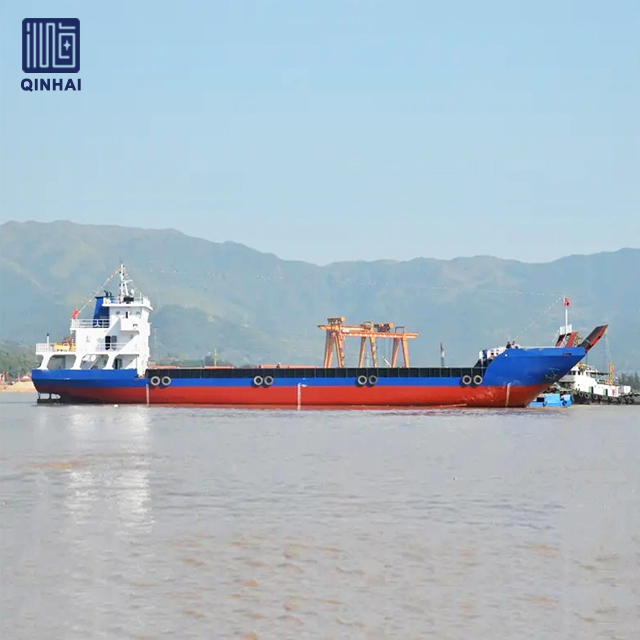
Physical features map directly to safety outcomes, operational compliance, and stowage execution. You cannot plan cargo layout based on square meterage alone. Stability physics and regulatory constraints dictate where every piece of cargo must sit. A poor stowage plan on a flat-bottom vessel leads to catastrophic cargo shifts.
The physics of flat-bottomed structures differ entirely from V-hull ships. Flat bottoms possess massive initial stability. They resist small rolling forces effectively because of their large waterplane area. However, this stability degrades rapidly at extreme roll angles. If the vessel rolls past a certain degree, the flat bottom loses its righting energy much faster than a conventional hull. The ship will not recover.
Cargo planners must distribute weight to maintain an optimal metacentric height (GM). If heavy cargo is placed too high on the deck, the center of gravity rises. This reduces the GM, making the vessel tender and prone to capsizing. If all heavy cargo is packed tightly at the bottom, the GM becomes too large. This results in a stiff vessel that snaps back violently during rolls. A stiff roll snaps cargo lashings and damages equipment. Proper stowage requires a calculated distribution of weight across the longitudinal and transverse axes to achieve a moderate, safe GM.
Cargo height interacts directly with vessel dimensions, specifically the height of the wheelhouse or bridge. Regulatory bodies enforce strict safety requirements for maintaining a clear line of sight from the bridge during navigation. International regulations dictate that the view of the sea surface from the conning position must not be obscured by more than two ship lengths or 500 meters, whichever is less.
If you load oversized modular housing or tall heavy machinery on the forward deck, you risk creating a blind spot. Cargo planners must calculate the height of the cargo against the elevation of the bridge deck. Tight wharf maneuvering becomes dangerous if the crew cannot see the dock, small craft, or mooring lines due to towering cargo blocking the view. You must leave sightlines open, which often means leaving usable deck space empty.
The bow ramp serves as the primary artery for cargo operations. Critical measurements include ramp length, ramp width, and the Safe Working Load (SWL). The width dictates whether wide-track mining excavators can board. The SWL determines the maximum weight of a single vehicle crossing the hinge point.
Tidal variations, bow shape, and ramp length dictate the loading gradient. A short ramp on a steep beach creates a sharp angle. Tracked vehicles might handle this, but long-wheelbase wheeled cargo will bottom out at the hinge. Planners must match the ramp dimensions to the expected shoreline gradients and the ground clearance of the Ro-Ro cargo. Lowboy trailers carrying heavy generators require extremely shallow ramp angles to prevent getting stuck during loading.
Deck loading limits are defined in tons per square meter (t/m²). While a vessel might have 3000 tons of available DWT, the deck plating might only support 5 t/m². Heavy machinery tracks or steel coils exert massive concentrated pressure on small areas of the deck. A 50-ton excavator resting on two narrow steel tracks can easily punch through standard deck plating if the point load exceeds the structural limit.
When cargo exceeds standard point loads, mitigation strategies become necessary. Planners use load-spreading mats, heavy timber dunnage, or custom steel grillage. These tools distribute the concentrated weight over a larger surface area. They transfer the load safely to the underlying transverse frames and longitudinal bulkheads.
| Cargo Type | Typical Point Load Issue | Recommended Mitigation Strategy |
|---|---|---|
| Tracked Excavators | High pressure on narrow steel tracks | Hardwood timber dunnage laid transversely across deck frames |
| Steel Coils | Extreme concentrated weight in a small footprint | Custom steel cradles and load-spreading I-beams |
| Modular Plant Equipment | Uneven weight distribution at four corner twist-locks | Steel grillage welded directly to deck frames |
| Heavy Forklifts | High front-axle loads during lifting operations | Reinforced steel plating installed in designated driving lanes |
| Wind Turbine Blades | Long span with concentrated weight at support saddles | Custom saddles aligned exactly over longitudinal bulkheads |
Environmental and infrastructural realities threaten deployment schedules. Vessel dimensions dictate port planning and dictate which routes are safe to navigate. Ignoring these constraints leads to grounded vessels, damaged cargo, and massive insurance claims.
Evaluating destination ports requires a strict checklist. You must verify water depth at low tide, the size of turning basins, and shore-side ramp compatibility. Port authorities use LOA and breadth to determine clearance protocols and assign berths. If your vessel's LOA exceeds the berth length, you cannot tie up securely. Spring lines and breast lines will not hold the vessel safely against the dock.
Grounding risks are severe in tidal ports. You must calculate safe under-keel clearance (UKC) based on the vessel's maximum loaded draft and the lowest astronomical tide. A flat-bottom vessel resting on a rocky seabed during low tide will suffer severe hull damage. Ensure the seabed is soft mud or sand if tidal grounding is expected during discharge operations.
Follow this strict protocol when evaluating a new beaching site:
Shallow-draft, flat-bottom vessels remain highly vulnerable to high sea states. They are prone to slamming. When the bow lifts over a wave and crashes down, the flat bottom impacts the water with massive force. This slamming causes structural fatigue, damages cargo lashings, and can buckle the hull plating.
LOA and freeboard dimensions dictate safe operational windows. A short LOA means the vessel will pitch violently in short-period waves. Low freeboard increases the risk of taking green water over the bow. Weather routing requirements for LCT vessels are far stricter than for deep-draft ocean freighters. Captains must hug the coast, utilize weather windows, and avoid beam seas that exploit the flat bottom's rapid loss of stability at high roll angles.
Procurement decisions rely on evaluating a shipyard's engineering capabilities. You need a builder who understands how dimension modifications impact stability and cargo capacity. Overall value is determined by how well the vessel matches your specific trade route, not just the initial purchase price.
Working with a capable China LCT vessel supplier allows you to modify standard designs. You might need to widen the beam by two meters to accommodate an extra lane of modular cargo footprints. You may need to alter the bow shape to match specific beaching angles at a remote mining site. Sometimes, reducing the draft by half a meter is mandatory to navigate a specific shallow river system during the dry season.
Evaluate the trade-offs between off-the-shelf designs and custom-built dimensions. Off-the-shelf designs offer shorter lead times and lower initial capital expenditure. Custom dimensions ensure maximum operational efficiency over the vessel's lifespan. A shipyard with strong in-house naval architecture can adjust the hull lines to meet your exact draft and deck area requirements without compromising stability or speed.
Vessel dimensions and structural scantlings must meet IACS (International Association of Classification Societies) standards. Scantlings refer to the thickness of the steel plates and the size of the internal framing. A wider beam or a longer LOA requires thicker steel and stronger frames to handle the increased bending moments and shear forces encountered at sea.
Ensure the supplier provides all documentation required for insurance and international chartering. Classification society approval guarantees that the vessel's dimensions, stability booklets, and load line calculations meet global safety regulations. Operating an unclassed vessel severely limits your ability to secure cargo contracts and insurance coverage. Port state control will detain vessels that lack proper classification certificates.
| Dimension Modification | Structural Impact | Required Engineering Adjustment |
|---|---|---|
| Increasing LOA | Higher longitudinal bending moments | Thicker keel plating and stronger longitudinal bulkheads |
| Widening Breadth | Increased transverse shear forces | Heavier transverse web frames and reinforced deck beams |
| Reducing Draft | Loss of displacement and buoyancy | Wider hull form to regain lost volume and maintain DWT |
| Increasing Deck Load Limit | Higher point load pressure | Thicker main deck plating and closer frame spacing |
Successful cargo operations hinge on a rigorous mathematical alignment between cargo weight, cargo footprint, port infrastructure, and LCT vessel dimensions. You cannot force a mismatch. The physics of stability and the realities of shallow-water navigation demand precise planning. Use 1000 to 3500 DWT vessels for coastal and riverine Ro-Ro operations where draft is the primary constraint. Scale up to 20000 DWT vessels with cranes for heavy-lift project cargo requiring self-sustained loading and massive deck space.
A: Draft varies significantly by capacity. Small 1000 DWT barges typically feature a shallow draft of 1.5 to 2.5 meters, ideal for riverine beaching. Large 20000 DWT vessels draw 5 to 7 meters. The flat-bottom design ensures that even massive LCTs maintain a shallower draft compared to conventional V-hull ships of similar tonnage.
A: Breadth determines the number of driving lanes available for Ro-Ro cargo, directly impacting deck utilization. A wider beam increases transverse stability, preventing dangerous listing when heavy equipment drives up the ramp. However, excessive breadth restricts turning capabilities in tight wharfs and limits access through narrow river channels.
A: LOA (Length Overall) measures the absolute maximum length of the vessel from the tip of the bow ramp to the stern. LBP (Length Between Perpendiculars) measures the length along the summer load line. LOA matters more for port clearance, turning basins, and physical berthing limits.
A: Yes, but with limitations. Flat-bottom designs are vulnerable to slamming in high sea states. While large LCTs can achieve ocean-going classification, they require specific freeboard dimensions, reinforced bow structures, and strict weather routing to avoid severe beam seas that compromise their stability curve.
A: Multiply the length and width of each cargo unit to find the footprint. Add a minimum of 0.5 to 1 meter around each unit for lashing clearances and crew access. Ensure the total weight does not exceed the deck's point-load limits, and verify that stacked cargo does not violate line-of-sight restrictions from the bridge.
A: Point load capacity dictates how much concentrated weight the steel deck can support per square meter. Heavy machinery tracks or steel coils can puncture or deform the deck plating if their concentrated weight exceeds the structural limit, even if the vessel has plenty of overall DWT capacity remaining.


