
Views: 0 Author: Site Editor Publish Time: 2026-07-15 Origin: Site


Chartering the wrong vessel for offshore operations leads to severe logistical bottlenecks, inflated day rates, and compromised project timelines. Procurement teams and project managers frequently encounter overlapping maritime terminology—specifically the interchangeable use of broad categories and specific vessel classes—complicating the technical evaluation of fleet requirements. When project parameters demand precise payload capacities and station-keeping capabilities, misunderstanding these classifications introduces significant operational risk.
Clarifying the hierarchical relationship and functional distinctions between the broader offshore support vessel category and the highly specialized platform supply vessel is the first step in aligning offshore logistics with project success criteria. Understanding the dynamics of OSV vs PSV ensures you deploy the right asset for the right operational phase. This technical alignment prevents over-specification, reduces unnecessary fuel consumption, and guarantees that drilling rigs and production platforms receive continuous, reliable support without costly interruptions.
Hierarchical Distinction: "OSV vs PSV" is not a comparison of two entirely separate entities; rather, a PSV is a highly specialized sub-category operating under the broader OSV (offshore support vessel) umbrella.
Functional Focus: While the broader offshore support vessel category includes vessels designed for towing, anchor handling, and subsea construction, the PSV vessel is engineered exclusively for maximum cargo capacity and logistical supply.
Procurement Driver: Vessel selection should be dictated by the specific phase of the offshore lifecycle—exploration requires high-power anchor handlers (a type of OSV), whereas active production platforms rely on the high-volume deck space of a PSV.
Cost Efficiency: Over-specifying a vessel by chartering a multi-purpose OSV when a dedicated platform supply vessel is required results in unnecessary fuel consumption and higher chartering premiums.
The term offshore support vessel serves as the parent classification for any specialized ship serving the offshore oil, gas, and wind industries. Industry professionals often use this term interchangeably with offshore supply vessel, but the technical definition encompasses a wide array of maritime assets. These vessels execute tasks ranging from initial site exploration to late-stage decommissioning. They provide the necessary muscle, technical interfaces, and safety nets required to maintain offshore infrastructure in hostile marine environments.
Within this broad group, several distinct sub-categories exist, each engineered for specific operational profiles. Understanding these distinctions helps project managers avoid chartering the wrong asset for a specific phase of field development.
Anchor Handling Tug Supply (AHTS) vessels: Built primarily for towing drilling rigs and positioning massive anchors. They feature heavy-duty winches, stern rollers, and immense engine power.
Multi-Purpose Support Vessels (MPSV) & Dive Support Vessels (DSV): Optimized for subsea construction. They facilitate ROV (Remote Operated Vehicle) deployment and complex seabed operations, such as riser and jumper connections.
Emergency Response and Rescue Vessels (ERRV): Dedicated entirely to standby, rescue, and safety services. They maintain a continuous presence near platforms to recover personnel during emergencies.
Seismic Survey Vessels: Designed to map the ocean floor and locate subsea oil and gas reserves using acoustic arrays.
The primary success criteria for general OSVs revolve around versatility, raw power, and the ability to support diverse subsea and surface operations. They must adapt to changing project demands, often carrying specialized modular equipment on deck to switch between construction, towing, and light supply roles as needed. A standard OSV might spend one week towing a rig and the next week deploying subsea manifolds.
A platform supply vessel is a dedicated logistics asset operating strictly within the broader OSV category. It does not tow rigs. It does not lay subsea cables. Instead, it functions as the primary logistical lifeline between onshore supply bases and offshore installations. Its entire design philosophy centers on moving maximum cargo volumes safely and efficiently across open ocean transit routes.
The core architectural focus of a PSV maximizes clear aft deck space and below-deck tank capacities. Naval architects push the superstructure as far forward as possible. This configuration creates a massive, unobstructed wooden or steel deck optimized for carrying drill pipes, casing, and heavy machinery. Below the main deck, the hull contains a complex network of segregated tanks equipped with specialized pumping systems.
The standard operational loop of a PSV vessel involves highly coordinated loading and discharging sequences. They transport essential drilling consumables like liquid mud, dry cement, and heavy brine. Simultaneously, they carry standard stores, fuel oil, fresh water, and provisions. Upon reaching the offshore rig, they utilize dynamic positioning to hold station while cranes transfer deck cargo and hoses pump bulk liquids upward to the platform.
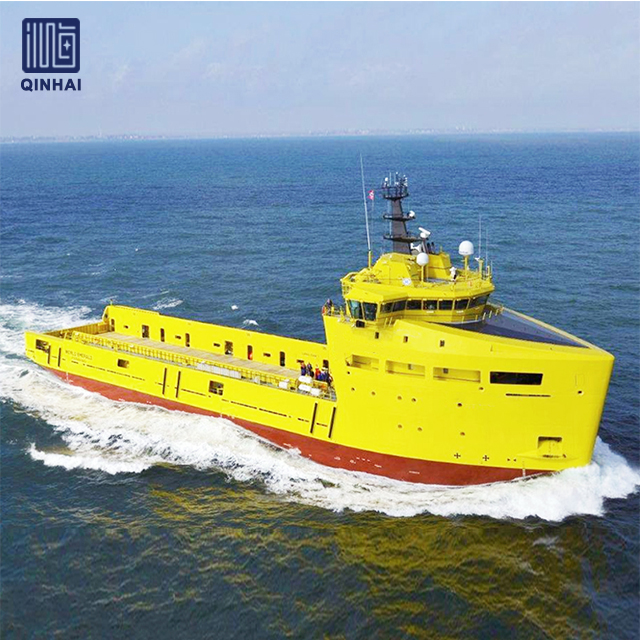
The most striking technical difference emerges when analyzing below-deck tank configurations. PSVs feature highly segregated, high-volume tanks specifically coated and agitated for dry bulk and liquid muds. They require complex piping manifolds to prevent cross-contamination between different drilling fluids. Conversely, other OSVs sacrifice this internal cargo space to house heavy machinery. An AHTS requires massive internal volume for towing winches and chain lockers, drastically reducing its capacity to carry liquid mud or brine.
Deck load capacities further highlight this divergence. PSVs are optimized for high deadweight tonnage (DWT). Their decks are reinforced to handle the safe loading and unloading of heavy pipes and machinery at sea. A standard MPSV might have a large deck, but much of that space is permanently occupied by A-frames, subsea cranes, ROV hangars, and dive spreads.
Technical Metric | Platform Supply Vessel (PSV) | General OSV (e.g., AHTS / MPSV) |
|---|---|---|
Primary Function | High-volume logistics and cargo transport | Towing, anchor handling, subsea construction |
Deck Space Utilization | Maximized clear area for pipes and cargo | Occupied by winches, cranes, and ROV spreads |
Below-Deck Capacity | Extensive segregated tanks for mud, cement, brine | Limited liquid cargo; space used for machinery |
Deadweight Tonnage (DWT) | Optimized for maximum payload (often 3000-5000+ tons) | Lower payload capacity relative to vessel size |
Winch and Towing Gear | None or minimal (mooring only) | Heavy-duty towing winches, stern rollers, shark jaws |
Bollard pull serves as the definitive metric for towing vessels. AHTS vessels require massive engine power to generate the bollard pull necessary for towing semi-submersible rigs and dragging multi-ton anchors across the seabed. Their propulsion systems feature large propellers operating inside nozzles to maximize thrust at low speeds. This raw power dictates their entire engine room layout.
PSVs completely ignore high bollard pull requirements. They prioritize fuel efficiency, transit speed, and station-keeping. Modern PSVs frequently utilize diesel-electric propulsion systems. Multiple smaller generator sets provide power to azimuth thrusters. This setup allows the vessel to run only the engines necessary for the current transit speed or weather conditions, significantly reducing fuel consumption during routine supply runs.
Dynamic Positioning (DP) systems are mandatory across modern offshore classifications, but their application varies. DP systems use satellite data, gyrocompasses, and wind sensors to automatically control thrusters, keeping the vessel exactly in position without using anchors. General OSVs might utilize DP1 or DP2 depending on their subsea construction roles.
PSVs rely heavily on DP2 systems to maintain a fixed position alongside a rig during cargo, fuel, and chemical transfers. Operating mere meters from a steel platform structure in adverse weather presents immense collision risks. DP2 provides redundancy; if one thruster or generator fails, the vessel maintains its position, preventing catastrophic impacts and environmental spills during liquid transfers.
During the initial phases of offshore field development, the operational focus centers on mobilization and seabed preparation. Rigs must be towed to the location. Mooring lines must be set. Subsea infrastructure, including manifolds and wellheads, requires precise installation. These tasks demand raw power and specialized lifting capabilities.
A multi-purpose offshore support vessel, AHTS, or subsea construction vessel is critical during this phase. A PSV cannot tow a rig or deploy a 100-ton subsea manifold. Project managers must secure vessels with high bollard pull, active heave-compensated cranes, and ROV deployment capabilities to execute riser and jumper installations efficiently.
Once a platform transitions from drilling to active production, the operational requirements shift dramatically. The need for heavy towing and subsea construction diminishes. Instead, the platform requires steady, high-volume logistical support to maintain daily operations and support the crew.
The platform supply vessel becomes the most operationally efficient choice for this phase. Using an AHTS to deliver fresh water and groceries wastes fuel and underutilizes the vessel's expensive towing machinery. A dedicated offshore supply vessel handles daily rig sustenance, equipment transfers, and waste management with unmatched efficiency, ensuring the platform remains fully stocked without incurring unnecessary chartering premiums.
The offshore wind sector continues to reshape vessel demand. Both OSVs and PSVs play evolving roles in renewable energy operations. During the construction of wind farms, heavy-lift OSVs and specialized anchor handlers position turbine foundations and lay export cables.
As wind farms enter the operational phase, traditional PSVs often transition into Service Operation Vessels (SOVs). These modified vessels feature motion-compensated gangways (walk-to-work systems) allowing technicians to safely access turbines in rough seas. Conversely, late-stage oil and gas decommissioning tasks rely heavily on heavy-lift OSVs to dismantle platforms and plug abandoned wells.
Chartering a high-spec AHTS or MPSV for a standard supply run introduces severe cost inefficiencies. These vessels carry heavy machinery that increases their baseline displacement, meaning they burn more fuel simply to move through the water. Their day rates reflect their specialized capabilities, making them an expensive choice for moving deck cargo.
Fuel consumption metrics heavily favor dedicated PSVs for pure logistics routes. PSVs equipped with diesel-electric or hybrid battery propulsion offer significantly lower operational expenditures (OPEX). They transit efficiently and use minimal power during DP operations at the rig, making them the financially sound choice for long-term supply contracts.
Vetting vessels against standards set by classification societies like DNV or ABS is non-negotiable. Regional authorities, including USCG guidelines for offshore operations, dictate strict structural and operational mandates. Vessels must hold the correct class notations for their intended tasks.
Compliance risks escalate when transporting hazardous materials. Liquid muds, heavy brines, and production chemicals require specific tank coatings, closed-loop venting systems, and specialized pumping manifolds. Furthermore, vessels operating in certain jurisdictions must carry specific standby, rescue, and pollution control certifications to operate legally near offshore installations.
Selecting a reliable offshore vessel supplier requires rigorous due diligence. You are not just chartering steel; you are integrating a third-party asset into your critical supply chain. Operational failures at sea immediately halt rig operations.
Evaluate suppliers across several key dimensions. Analyze the fleet age; newer vessels generally offer better fuel efficiency and lower breakdown probabilities. Scrutinize maintenance records and DP incident histories to gauge operational reliability. Assess crew competency through training matrices. Finally, verify ESG compliance, specifically focusing on emissions tracking and carbon intensity indicator ratings, to align with modern corporate sustainability goals.
Define exact deadweight tonnage (DWT) requirements and specific below-deck tank capacities based on the drilling program's fluid demands.
Determine the required DP class (typically DP2) based on the environmental conditions of the offshore location.
Compile a comprehensive mission profile detailing required deck space, crane capacities, and transit distances.
Issue a targeted Request for Proposal (RFP) to a vetted offshore vessel supplier or shipbroker, specifying the exact vessel sub-class required.
A: OSV stands for Offshore Support Vessel or Offshore Supply Vessel. It is a broad category of specialized ships designed to serve the offshore energy sectors, including oil, gas, and wind. This umbrella term covers various vessels, including anchor handlers, dive support vessels, and platform supply vessels.
A: The primary function of a PSV is to transport essential cargo to and from offshore rigs and platforms. They deliver fuel, fresh water, drilling fluids, cement, specialized equipment, and provisions. They are engineered to maximize clear deck space and internal tank capacity for efficient logistics.
A: An Anchor Handling Tug Supply (AHTS) vessel is classified as an OSV, but it is distinct from a PSV. While an AHTS can carry some supplies, its primary design focuses on high engine power, towing winches, and anchor-handling capabilities required for moving and mooring drilling rigs.
A: Industry professionals frequently use the terms interchangeably. However, "support" technically encompasses a wider range of non-supply roles, such as dive support, subsea construction, and standby rescue. "Supply" usually refers more specifically to the logistical transport of goods and fluids.
A: PSVs require Dynamic Positioning to safely hold their exact position close to an offshore platform during cargo and fluid transfers. DP systems use automated thrusters to counteract wind, waves, and currents without relying on anchors, preventing collisions and ensuring safe operations in rough seas.


